How to aim in physics puzzles: gravity, magnets, pegs and cannons
Updated: November 27, 2026 · Gizo Game
Physics puzzles look chaotic, but they follow rules that never change. A seed bends around a planet in exactly the same way every time. A ball bounces off a peg at the same angle every time. Once you trust that, aiming stops being luck and becomes a small experiment you can repeat.
This guide collects the habits that help in four of our physics games. They are different games, but the advice overlaps more than you would expect.
Trust the preview, then nudge
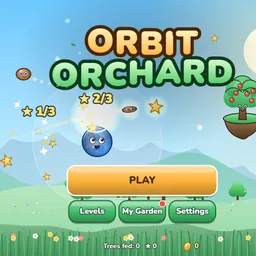
In Orbit Orchard you slingshot a fruit seed across a garden of planets, and gravity bends its path. The dotted preview line is drawn with the same physics as the real flight, including how orbiting planets will have moved by then. What the dots show is what the seed does.
After each shot the game keeps your angle and power, so the next attempt starts from where you left off. Use that. Do not start again from scratch: change one thing a little and watch what the preview does. The later levels leave little room for error, so expect to adjust in small steps.
Learn what each object does to your shot
Physics games introduce their objects slowly, and it pays to read those first levels properly. In Orbit Orchard the first levels have a single planet: aim a little past it on the side of the tree and let gravity do the curving. Spiky blooms push the seed away, so you can use one like a soft wall that turns the seed toward the tree. Jelly planets bounce the seed instead of destroying it, which means a bounce can be part of the route.
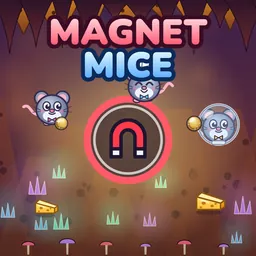
Magnet Mice works the same way. A magnet pulls steel balls but not mice, and the dashed ring on screen shows its range; touching the ball's path with that ring is often enough. The repeller pushes balls away but only nudges mice. The wind gate pushes along a long, narrow strip and weakens with distance, so set its direction exactly with the yellow knob. The same wind pushes mice too, which can help or ruin your plan.
Plan for chains, not single hits
Plink Parade is about drops that set off other things. The ball's colour shows in the funnel before you release it, so drop it where bulbs of that colour are clustered; even one matching bulb can light the ones around it. Bombs set each other off when they sit close together, so line them up near groups of bulbs and a single hit becomes a chain.
Special balls are worth saving. The Heavy ball breaks crystals in one hit, the Split ball divides into three at its first collision and covers a wide area, and the Blast ball explodes like a bomb on first contact. Each still counts as one of your balls, and the stock in each level is limited, so use them where the board needs them.
Test shots are free
Cannon Cove gives you five shots per level, so the first shot is best treated as a test. See where it lands, then adjust. You almost never need full power. Aim for the base of a tower rather than the pirate on top, because a falling block crushes everything above it. Look for explosive barrels: one hit can start a chain that clears a whole ship.
Wind and waves move things between shots, so a test shot also tells you how the level is behaving today. Use the right ball for the job: Grapeshot for spread-out targets, the Skipper for ships sitting on the waterline.
When you are stuck
Take a breath and look at the whole board instead of the target. Ask what the objects in front of you are for, because levels are built so that each one has a purpose. If a game has a hint button, use it as a lesson rather than a shortcut. In Orbit Orchard, for example, the hint shows a recorded solution path, and studying it often teaches you a trick you can use on later levels.